
Valenciaport demonstrates new hydrogen-powered equipment
The European H2PORTS project, led by the Fundación Valenciaport,
has organised a public demonstration for the world’s first hydrogen-powered
ReachStacker and the 4×4 tractor unit.
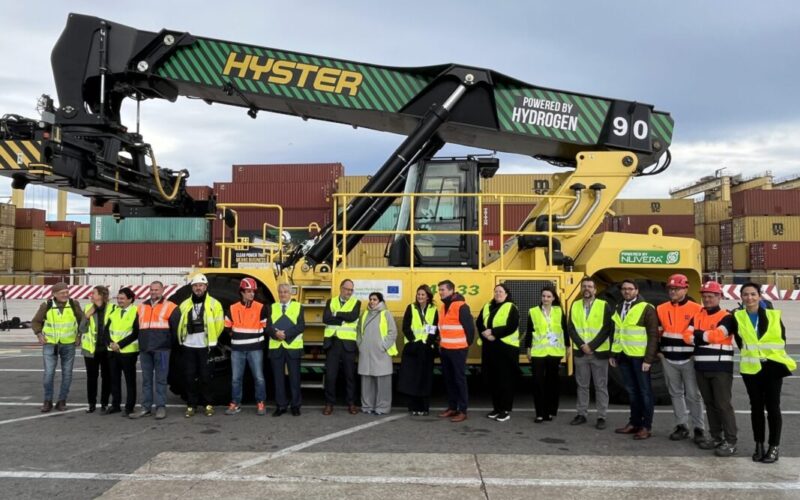
The demonstration event took place in the auditorium of the Port Authority
of Valencia (PAV), and then at the MSCTV terminal and Valencia Terminal Europa
(VALTE), where the participants were able to see the machines in operation.
The hydrogen ReachStacker on display was a zero-emission solution that uses
a fuel cell from the manufacturer Nuvera to convert hydrogen into
electricity.
The machine arrived at the MSC terminal for testing in September 2023,
becoming the first ReachStacker-type machine in Europe to use hydrogen fuel cell
technologies for port handling equipment in real operating conditions.
Hydrogen is stored on board the ReachStacker in high-pressure tanks that
can be refilled in 10-15 minutes. The hydrogen fuel cell supplies power to the
electric motors or returns it to the batteries depending on the demand of the
task, while reducing greenhouse gas (GHG) emissions and noise pollution compared
to a diesel alternative and with similar performance.
In addition, eliminating the diesel engine, transmission, and other
mechanical drive components from the ReachStacker can help ports reduce
operating costs.
Attendees then travelled to the VALTE terminal where they were able to see
in detail the world’s first hydrogen-powered terminal tractor, which was
developed by ATENA with the support of ENEA and the Parthenope University of
Naples.
The terminal tractor loaded with renewable hydrogen, reportedly
demonstrated its autonomy, reliability, and power by hitching up a truck trailer
and driving around the terminal.
The test was observed by the more than 150 people attending the
demonstration, who saw how the only residue of the hydrogen combustion was water
droplets, the Port of Valencia reported.
This Terminal Tractor has a fuel cell/battery hybrid powertrain which
allows the vehicle to perform all the intensive tasks that are required during
RoRo operations. Its hydrogen storage system, made of four Type 3 cylindres (350
bar), has an overall capacity of around 12 kilogrammes (kg), which guarantees a
continuous operation of at least 6 hours before refuelling, corresponding to the
average duration of a working shift.
The electric motor is fed by a high-performance LiFePO4 battery, with 25
kwh energy capacity, and a 70 kW Ballard fuel cell module. In particular, the
electric motor can reportedly receive power for traction from the fuel cell and
battery simultaneously or charge the battery during braking or
decelerations.
At the same time, the fuel cell can provide power both to the electric
motor and the battery, if needed, according to Valenciaport.
The participants finally visited the hydrogen station, developed by the
Spanish National Hydrogen Centre (CNH2), and learned about the
details of the hydrogen supply and refuelling management carried out by the
company Carburos Metálicos. This supply station consists of a fixed part,
located on the Xità quay, and a mobile part, which is used for refuelling.
Last month, Fundación Valenciaport began work on the METEOR project, an
initiative that seeks to increase the safety of maritime transport, specifically
of goods transported by container.
More recently, the THEMIS 5.0 Project had its kick-off meeting in Athens,
an initiative whose ultimate goal is to revolutionise the way we all interact
and perceive Artificial Intelligence (AI), participated by the Valenciaport
Foundation.