
MPA Singapore, Port of Rotterdam establish world-longest green corridor
The Maritime and Port Authority of Singapore (MPA) and the Port of
Rotterdam Authority have signed a Memorandum of Understanding (MoU) to establish
the world’s longest Green and Digital Corridor to enable low and zero carbon
shipping.
The port authorities will work with the Global Centre for Maritime
Decarbonisation and the Mærsk Mc-Kinney Møller Center for Zero-Carbon Shipping
as action partners, as well as other industry partners across the supply chain,
including bp, CMA CGM, Digital Container Shipping Association (DCSA), Maersk,
MSC, Ocean Network Express, PSA International, and Shell amongst others.
The cross-industry partnerships will enable the Green and Digital Corridor
project to raise investment confidence, attract green financing, and kickstart
joint bunkering pilots and trials for digitalisation and the use of low- and
zero carbon fuels along the route.
Singapore and Rotterdam are among the largest bunkering ports in the world,
making them key links on the Asian-European shipping lanes.
While international shipping currently uses largely marine gas oil (MGO)
and low-sulphur fuel oil, sustainable alternatives such as biofuels, including
biogases, are increasingly being made available.
Other alternatives such as synthetic methane, hydrogen, and hydrogen-based
fuels including ammonia and methanol are in various stages of R&D for future
trials and deployment.
Each alternative fuel has its own challenges relating to costs,
availability, safety, and restrictions in range due to lower energy density
compared to fossil fuels.
To tackle these challenges, the two port authorities agreed to bring
together a broad coalition of shippers, fuel suppliers and other companies to
collectively work on potential solutions.
Beyond alternative fuels, the MoU also aims to optimise maritime
efficiency, safety, and the transparent flow of goods by creating a digital
trade lane where relevant data, electronic documentation and standards are
shared. This will facilitate the seamless movement of vessels and cargo, and
optimise just-in-time arrival of vessels from port to port.
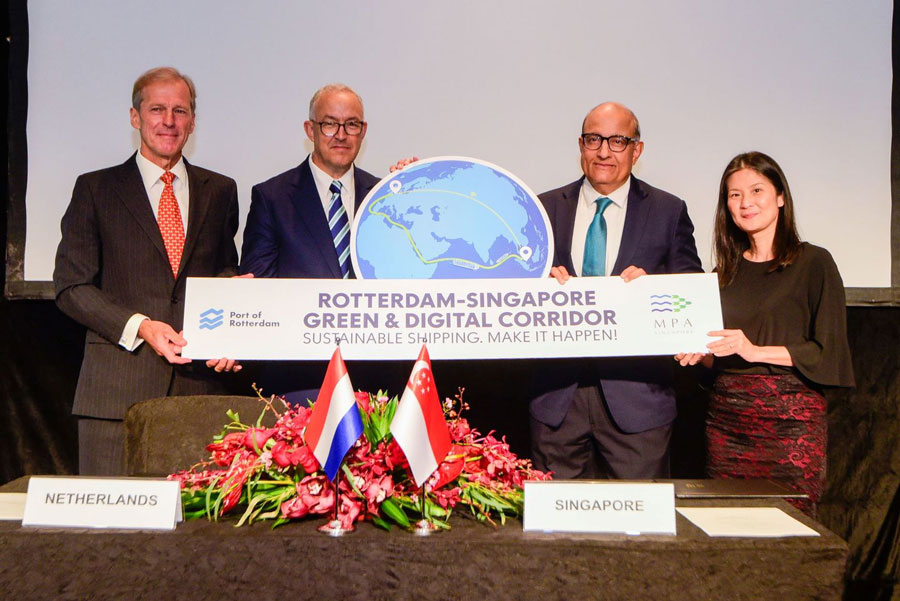
Signed by Quah Ley Hoon, Chief Executive of MPA, and Allard Castelein, CEO
of the Port of Rotterdam Authority at the Marina Bay Sands Convention Centre on
the sidelines of the biennial World Cities Summit, the MoU will bring together
stakeholders across the supply chain to realise the first sustainable vessels
sailing on the route by 2027.
The signing was witnessed by S Iswaran, Minister for Transport and
Minister-in-Charge of Trade Relations, Singapore, and Ahmed Aboutaleb, Mayor of
Rotterdam.
S Iswaran, Minister for Transport and Minister-in-Charge of Trade
Relations, Singapore, said: “Decarbonising shipping is an urgent climate action
priority, which requires the collective efforts of the entire maritime sector.
As a trusted global maritime hub, Singapore contributes actively to IMO’s
efforts to make international shipping more sustainable, and global supply
chains more resilient.”
Allard Castelein, CEO of the Port of Rotterdam Authority, said: “Shipping
is among the most important industries to decarbonise, owing to its large
international reach and volume, which continues to grow.
“By bringing together parties across the supply chain along one of the
world’s biggest trade lanes, we can enable carriers to switch to zero-carbon
fuels and speed up the transition to more sustainable shipping”.
Quah Ley Hoon, Chief Executive of MPA, said: “This MoU further strengthens
the strong partnership between Singapore and Rotterdam. It reaffirms Singapore’s
commitment towards facilitating a multi-fuel bunkering transition as part of the
Maritime Singapore Decarbonisation Blueprint 2050, and accelerates our
digitalisation efforts to optimise maritime efficiency and improve supply chain
resilience.”
In July Shell took its final investment decision to build Europe’s largest
green hydrogen plant on Maasvlakte 2 at the Port of Rotterdam.