
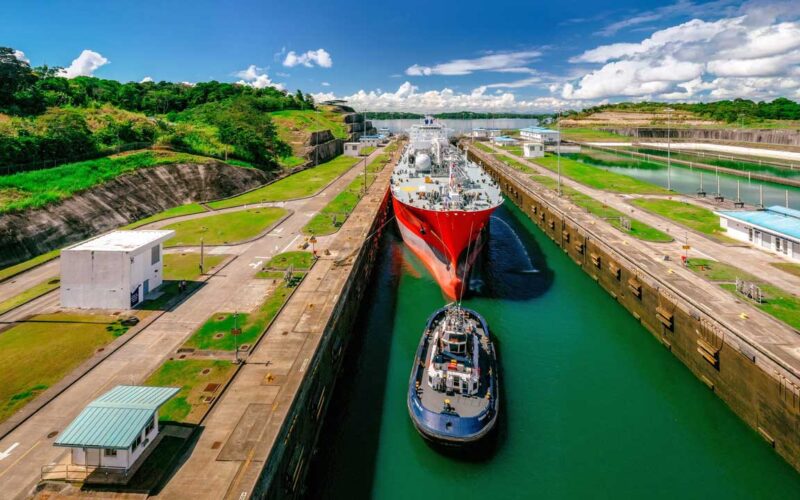
Over 100 ships clogged outside Panama Canal
The Panama Canal Authority (PCA) has opted to limit the daily
transits in response to rising congestion.
The prolonged dry season is a natural phenomenon that affects many regions,
including the Panama Canal, the PCA has therefore worked to adapt its operations
to ensure a competitive flow of vessels.
The standard offering of reservations comprises 23 booking slots for the
Panamax locks. Under Condition 2, in scenarios involving a substantial reduction
in capacity (such as lane closures for maintenance), the allocation is reduced
to 16 booking slots.
Meanwhile, under Condition 3, as currently being implemented, the booking
slots are limited to 14 in total (comprising 10 slots for super-sized vessels
and 4 slots for regular-sized vessels).
“This allows us to manage congestion and ensures ships en route or in
queue, which haven’t secured reservations, can still transit in competitive time
frames,” the PCA said in a statement.
“It should be noted that transits through the Neopanamax locks maintain
their regular average of 10 transits per day, so these have not been impacted by
the measure.”
The PCA has underscored the precise congestion statistics at both canal
entrances. This comes as a response to deceptive reports that have recently
asserted a lineup of 200 ships.
“The Panama Canal believes in transparency and permanent communication”,
reads its latest statement.
“We inform in advance of the measures that may influence our customers’
operations so that they can make business decisions, ensuring the sustainability
and continuity of world trade.”
As of 22 August, the authority reported 120 vessels waiting for transit.
For this month, the average waiting time for unbooked transits is between 9 and
11 days.
This announcement comes less than two weeks after the PCA announced a
temporary restriction on the number of new reserved passage slots to alleviate
the bottleneck of ships awaiting transit without reservation.