
Study maps hydrogen derivatives in Baltic Sea ports
The H2Deri@BSP project has released a comprehensive market analysis covering hydrogen derivatives across the Baltic Sea Region.
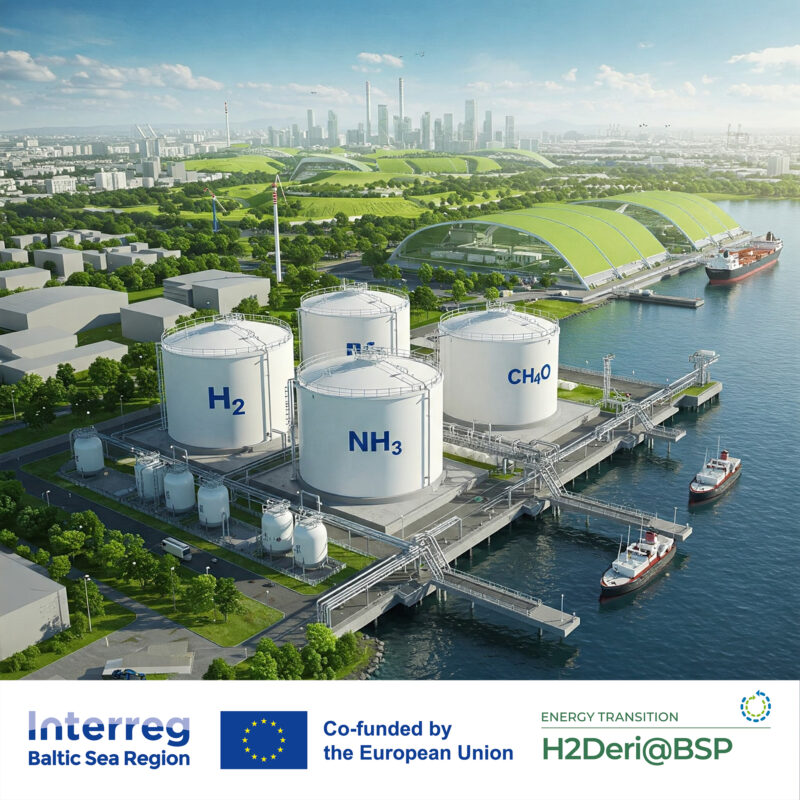
The report provides an in-depth look at current and projected demand, production capacities, infrastructure preparedness, regulatory developments, and the region’s import–export potential.
Drawing on extensive literature reviews, surveys, interviews, and workshops, the analysis mapped nearly 300 hydrogen-related initiatives – most of which are still in planning or feasibility phases.
Findings show that the Baltic Sea Region is gaining momentum in renewable maritime fuels, but hydrogen derivatives are still in their early stages.
EU regulations such as FuelEU Maritime, AFIR, and ETS are beginning to shape the market, but fragmented policies and slow national implementation limit large-scale deployment.
Ports are central to this transition. Some are already planning or implementing bunkering and storage infrastructure for renewable fuels.
Existing hubs leverage their expertise and networks, while ports near new production facilities can gain cost advantages, broadening the range of key bunkering locations.
If planned projects are realised, hydrogen-derived energy production could reach 338 terawatt-hours (TWh), equivalent to 31 million tonnes of marine gasoil, by 2030 and beyond.
Today, only 2 per cent of this capacity is operational, with Denmark, Germany, Finland, and Sweden leading production.
Earlier this month, construction of the Hamburg Green Hydrogen Hub (HGHH) began as Hamburg’s First Mayor Dr Peter Tschentscher laid the foundation stone for the 100-megawatt (MW) electrolyser at the former Moorburg power plant site.