
First Newbuild Inland Hydrogen Cargo Vessel Prepares to Enter Service
The first newly built hydrogen-powered vessel is preparing to enter service
as part of a demonstration program in the Netherlands designed to support the
development of zero-emission shipping. Shipbuilder Concordia Damen reports the
vessel recently completed technical sea trials and received a provisional
certificate, while on Tuesday, Dutch King Willem-Alexander visited the vessel to
mark its entry into service.
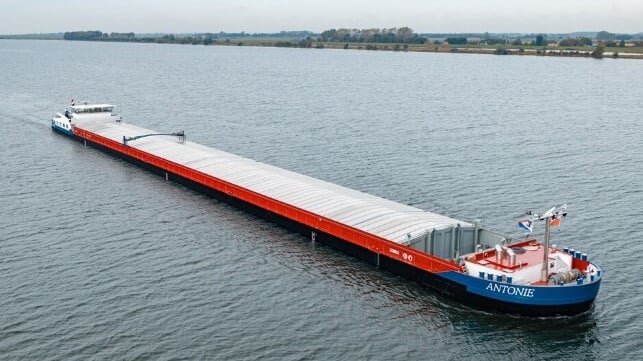
Named the Antonie, the vessel is approximately 443 feet in length with a
cargo capacity of 3,700 tons and boasts a revolutionary fuel cell propulsion.
The power from the hydrogen fuel cells will be converted to electricity to drive
the vessel versus conventional inland shipping which relies on diesel fuel.
Concordia Damen, which is leading the construction project for Dutch shipowner
Lenten Scheepvaart reports the fuel cell has been installed on the ship. They
expect the hydrogen containers to arrive and be installed by the end of the
year, at which time the vessel will be ready to go into service.
The order for the ship was placed in 2021 as part of a project to
demonstrate hydrogen-fueled propulsion. The government of the Netherlands
provided a $4.9 million construction subsidy to Lenten Scheepvaart. Construction
of the hull was completed in China at the Yizheng Yangzi Shipbuilding Co. (YZCB)
where the vessel was launched late in 2022. It was loaded onto a heavy-lift
vessel to be transported to the Concordia Damen shipyard where the installation
of the propulsion system was completed along with the fitting of the deckhouse
and outfitting.
The technical sea trails were completed on October 23 with a focus on
testing the advanced diesel-electric propulsion system. Lloyd’s Register also
inspected the vessel and issued a provisional certificate for it to enter
service.
"The fuel cell will soon serve as an energy supplier for the battery packs
after the installation of the distribution panel and the placement of the
hydrogen containers,” explains Bart van Driel, project manager at Concordia
Damen. “Once the distribution panel is delivered, it is just a matter of sizing
and manufacturing the final pieces of piping and adjusting the fuel cell
installation itself. The diesel generator will then no longer be used, so the
Antonie will sail completely emission-free."
When the vessel enters service, it will operate under charter to Nobian, an
industrial chemical company spun out from Nouryon (the former specialty chemical
business of AkzoNobel), transporting salt from Delfzijl in the Netherlands to
the Nobian plant in the Botlek. The company turns salt into chlor-alkali, among
other things, with hydrogen as a residual product. The hydrogen produced in the
chlor-alkali production process will be used as fuel for the Antonie.
With three hydrogen containers on board, the Antonie will have enough
energy available for full zero-emission transport between
Delfzijl-Rotterdam-Delfzijl. A hydrogen bunker station has also been built in
Delfzijl.
The unique nature of the project was highlighted by King Willem-Alexander
during his visit to the Antonie in Duisburg on November 14. The King met with
Prime Minister Hendrik Wüst of the German state of North Rhine-Westphalia and
toured hydrogen projects and the port of Duisburg, which is preparing to become
a transshipment point for clean energy forms. Several cooperation agreements
were signed during the visit to the port including for connection of national
hydrogen pipeline networks and the Delta Rhine Corridor. During the event, the
King and Prime Minister highlighted that the aim is for ten inland vessels and
at least four hydrogen filling stations to support operations between Rotterdam,
Duisburg, and Cologne by 2026.
In addition to the Antonie, several projects are converting existing
vessels in the Netherlands and the Benelux region to hydrogen. The port of
Rotterdam is also working with Damen and others in the development of hydrogen
and the infrastructure at the port to support it as an alternative fuel.
Earlier this year, the retrofit to install hydrogen fuel cells on the first
inland containership was completed in the Netherlands. Compagnie Maritime
Belgique (CMB) launched the first hydrogen-powered crew transfer vessel in 2022
and the Port of Antwerp is currently preparing for the introduction of a
hydrogen-fueled tugboat.