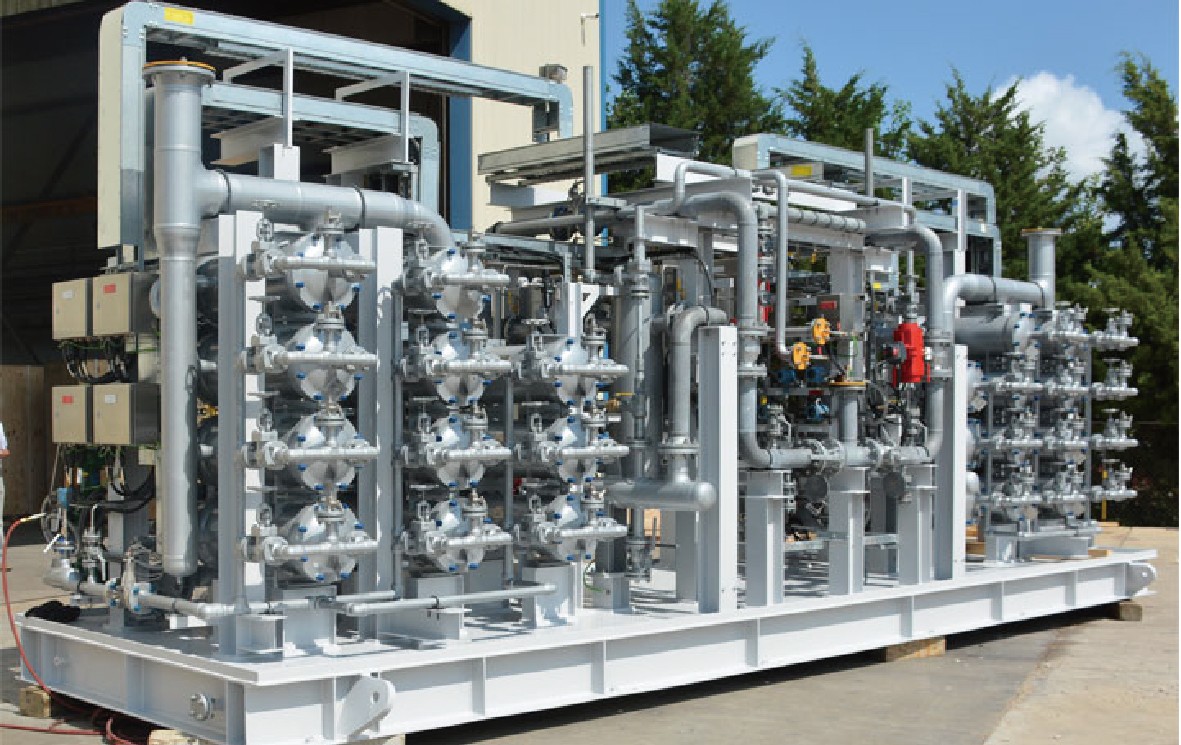
GAS MEMBRANE SEPARATION SYSTEM
The global climate is becoming warmer and warmer, and the greenhouse effect
is becoming more and more prominent. Reducing carbon dioxide (CO2) emissions and
reducing the greenhouse effect are the focus of attention of all countries in
the world. By making full use of renewable energy fuels, countries continue to
improve production and energy efficiency, while using gas membrane separation
technology to implement carbon capture and storage (CCS) technology to
effectively prevent carbon emissions, so as to achieve low-carbon green cycle
development and carbon emission targets required by countries.
As a "green technology", gas membrane separation technology can be used in
smelting, petroleum, petrochemical, natural gas, medicine and other fields,
which plays a key role in greatly reducing the emission of harmful gases such as
CO2 , improving the recovery rate of useful gases, enhancing efficiency and
saving production costs. However, the permeability coefficient and separation
coefficient of the general gas membrane separation technology are not high
enough to be applied in the industrial field on a large scale. After years of
joint research and development with our partners, the capture rate of the newly
developed gas membrane separation system is as high as 95%, and the purity is as
high as 99%. the annual catch of a single membrane module can reach more than
300,000 tons. The product quality is in the leading position in the field of gas
membrane separation technology, and has been widely used in the industrial
field.
ADVANTAGES
1. HIGH PURITY – The purity of the separated gas can reach 99%;
2. HIGH CAPTURE RATE – The capture rate can reach 95%;
3. HIGH CAPTURE – The annual catch of a single membrane module can reach more than 300,000 tons.
APPLICATION
1. CARBON CAPTURE
Coal-fired power plants, steel plants, natural gas power plants, cement plants and other industries.
2. PETROCHEMICAL GAS SEPARATION
Polypropylene production, polyethylene production, ethylene oxide and vinyl acetate monomer production, gas recovery, polyvinyl chloride production, etc.
3. NATURAL GAS SEPARATION
Natural gas purification treatment, denitrification, decarbonization, biogas CO2 removal, H2S removal, liquefied petroleum gas recovery.
4. REFINERY AND SYNGAS
Refinery gas upgrades, hydrogen recovery (renewable diesel, hydrotreating), hydrogen separation during synthesis gas preparation, CO2 removal from synthesis gas, hydrogen recovery from ammonia plant purge gas, purging from methanol plants Hydrogen is recovered from the gas.
5. DEHYDRATION
Solvent dehydration, isopropanol dehydration, ethanol dehydration, acetonitrile dehydration, tetrahydrofuran dehydration.